
Business English vs English Communication Coaching: What Works for Entrepreneurs?

Updated: Jul 12
Business English teaches the vocabulary and etiquette of a corporate workplace.
English communication coaching for entrepreneurs goes further, working with the confidence, identity and real speaking performance needed to sell, be visible, and build trust as the face of your own business. If you already know English but freeze, over-explain or hold back when it matters, coaching is very likely what you need, not another course.

As an entrepreneur, if you've searched for how to improve your English for business, you've probably landed on the same answer everyone does: take a Business English course.
It sounds like the logical solution it's for business after all. But here's what I've learnt after years working first as a certified English teacher, now as an English communication coach for entrepreneurs....most of the entrepreneurs I work with aren't struggling because they don't know enough English.
Entrepreneurs are struggling because their English communication doesn't reflect the expertise, personality and ideas they've actually built their business on.
That's the real difference between business English and English communication coaching.
And if you're an entrepreneur trying to grow in English-speaking markets, it's the difference that decides whether the next course you take actually moves you towards effective, natural and authentic English communication skills you need.
What Does Business English Actually Cover?
Business English is built for the corporate world.
Most courses are organised around topics like:
Company structures and organisational charts
Different departments within a business
Workplace responsibilities and job roles
Writing professional emails
Office processes and procedures
Common business meeting language
Handling everyday workplace problems
If you're an employee inside a company, it can be useful. It helps you navigate professional vocabulary, participate in meetings and communicate with colleagues across an international workplace.
But it's designed to serve everyone — different industries, different roles, different levels — in one broad curriculum. It has to be general. It's not built for you.
Notice, too, how much of that list is written communication. Emails, structures, processes on paper. And that matters more now than ever, because writing is exactly what AI can help you with in the moment or to learn independently.
What AI cannot do is get on the call for you. It cannot speak on your podcast, present on your stage, or hold a room's attention while you sell your offer live.
Speaking for yourself, in real time, under real pressure, is the one skill nothing or no-one else can do on your behalf.
It is also the skill business English spends the least time actually training!
Why do you think you have problems with communicating in the first place? When you are doing speaking exercises, you're talking to non-natives who're also making mistakes and aren't able to speak fluently. You're not spending the 2 hour class talking directly to a native or advanced English speaker you can actually learn from....
Why Don't Business English Courses Work for Entrepreneurs?
I've taught inside that system. I've seen the textbooks organised around imaginary company structures, departments, generic office small talk.
Useful for some. Almost irrelevant for entrepreneurs.
You're not sitting in meetings about departmental workflows. You're trying to:
Explain your expertise to a potential client in a way that builds instant trust
Sell your offer on a call without freezing or over-explaining
Create content in English that actually sounds like you
Speak on podcasts, on stage, on camera
Build relationships with international clients who need to believe in you fast
Represent a brand to the public
None of that is "workplace English." It's personal. It's the whole business, riding on how you show up and speak.
The real question was never "how do I communicate inside a company?"
It's: "how do I communicate who I am, what I know, and why someone should trust me in English — inside MY company,?"
Why This Runs Deeper Than Language
Here's what most people miss. English teachers are trained to teach language. They are not trained to work with fear, identity or confidence — and for an entrepreneur, that layer isn't separate from your business. It lives, breathes and screams in every aspect of your business because your business is an extension of you (I always say entrepreneurship is really a journey of self development).
Someone working inside a company has a safety net. They represent the business. If a call goes badly, the company absorbs some of that reputation. There's distance between their self-worth and the outcome.
An entrepreneur has no safety net. You are the business. Every piece of visibility is personal — the post that gets no engagement, the sales call that ends in silence, the podcast episode nobody comments on, your own family watching you build something from nothing whilst, some days, no one around you quite believes it'll work.
Now try doing all of that in a second language and bringing in all the insecurities you feel about your English.
This isn't two problems sitting side by side. Your emotional state directly shapes how your English comes out. Fear blocks your delivery. Self-doubt sounds like hesitation, over-explaining, apologising before you've even said the thing. Confidence — or the lack of it — doesn't sit next to your English performance. It is your performance. And it shapes how your business is perceived and how fast it grows.
Business English can teach you vocabulary and language. It can't deeply explore or create who you want to be, in English, as the person building this business. That's coaching work — moving someone through fear into a new identity — not teaching work.
As a certified life coach as well as an English communication specialist, this is exactly where I work: the practical language and the confidence underneath it. Miss either one, and the real confidence blocks stays untouched, your English doesn't flow and you still feel like you don't have enough English, but actually you're just scared.
What Is English Communication Coaching for Entrepreneurs?
Instead of asking "what English does a business person generally need?", my English communication coaching asks: "what does this entrepreneur need to communicate effectively in their actual business?"
That means working on:
Communicating complex ideas without translating in your head first
Explaining your expertise with zero hesitation
Deepening your language processing under pressure
Speaking with real confidence on client and sales calls
Presenting your ideas persuasively, live or on camera
Creating English content that sounds like you, not a script
Building an authentic English speaking style — not a performed one
For entrepreneurs building a business in English, this isn't a nice-to-have. It's the tool for connection, visibility, influence and growth.
Business English vs English Communication Coaching:
Side-by-Side Comparison
Business English | English Communication Coaching | |
Built for | Employees inside a company | Entrepreneurs building their own visibility |
Focus | Workplace vocabulary and etiquette | Confidence, identity and real speaking performance |
Curriculum | Broad and generic, serves many learners | Personalised around your calls, content and pitches |
Core skill trained | Written English (emails, reports) | Spoken English under real pressure |
Confidence and identity work | Not included | Central to the method |
Practice format | Group classes, hypothetical scenarios | Targeted, one-to-one, real business situations |
Led by | English teacher | Certified coach and English specialist |
The Energetic Fluency Method
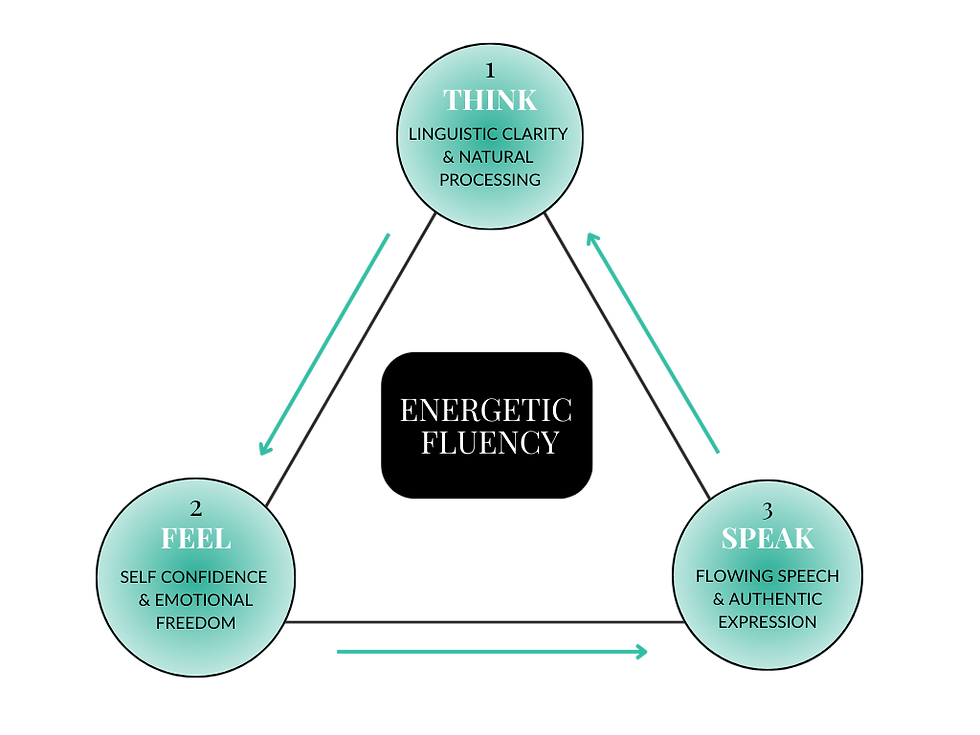
At Utter Eloquence, English communication coaching for entrepreneurs runs on the Energetic Fluency Method — three stages, one system: Think. Feel. Speak.
Think — natural English processing.
Deepens how you process English at its core, moving you out of translation and into direct expression, using neurolinguistic and conversation-based methods, not textbook drilling.
(Read my article How to Think in English for more information)
Feel — self confidence and identity coaching for entrepreneurs.
Works directly with the fear, self-doubt and invisible standards shaping how you show up speaking English in your business — so you stay connected to yourself whilst visible, instead of just managing an inner critic.
Speak — strategic, real-world application.
Applied straight into your client calls, sales conversations, pitches, podcasts, video and content. Refined for delivery, tone and presence, then taken into the real world.
Your English should support your business. Not limit it.
So Which One Do You Actually Need?
Business English has its place — for mid-level professionals inside a company who need general workplace language.
But if you're an entrepreneur trying to grow your business, build trust fast, and finally feel confident speaking English with clients, on camera, and in your content — you need coaching that works with the language and the identity underneath it.
English communication coaching is designed to directly support your real work. It's not a course you pause your business for. It's built around the calls you're already booking, the content you're already creating, the pitches you're already giving — and it gets rebuilt, if you're just starting out, to grow with you from the very beginning.
The goal was never just to improve your English.
It's for you to finally speak like you.
If this sounds like where you are, the next step is a conversation, not another course.
Book a 90 minute Energetic Fluency Audit to uncover what's actually holding your English communication back, and whether coaching is the right fit.
If you'd like to discuss a full personalised program, book a free consultation to discuss if Audience Ready English or Speak Like You is more suitable for you at this time.
Frequently Asked Questions
What is the difference between Business English and English communication coaching? Business English teaches workplace vocabulary and general corporate communication for employees inside a company. English communication coaching for entrepreneurs works with the confidence, identity and real speaking performance needed to sell, be visible and build trust as the face of a business, not just an employee.
Why doesn't Business English work well for entrepreneurs? Business English courses are built broadly to serve many employees across industries and focus on workplace scenarios like meetings, emails and office procedures. Entrepreneurs need English for client trust, sales conversations, content creation and public visibility, which requires a more personalised, identity-aware approach.
Can AI replace English communication coaching for entrepreneurs? AI can help with written English, such as emails and proposals, but it cannot speak on a call, present on stage or hold a room's attention on your behalf. Speaking confidently and authentically for yourself remains a skill that only real coaching and practice can build.
Who is English communication coaching for? English communication coaching is designed for entrepreneurs who need to communicate their expertise, sell their offers, and build trust in English, whether they are established and scaling into English-speaking markets or just starting out.

About the Author
Eleanor Amy Wilkinson is a British native English Communication Coach in Ljubljana and the founder of Utter Eloquence.
Through her Energetic Fluency Method, she helps entrepreneurs communicate their ideas and expertise in English, where language, identity and confidence meet.



Comments